
The Unmanned Forklift Truck market is moving into a new phase. It is no longer enough for a machine to simply drive automatically. What matters now is whether it can improve real loading efficiency, reduce repetitive labor, and create measurable productivity gains in daily operations.
That is exactly why Toyota’s latest development in Japan deserves attention. From what we can see, this is not just another automation concept or a typical AGF update. It reflects a more practical direction in the evolution of the Unmanned Forklift Truck, especially in truck loading and unloading applications where every cycle matters.
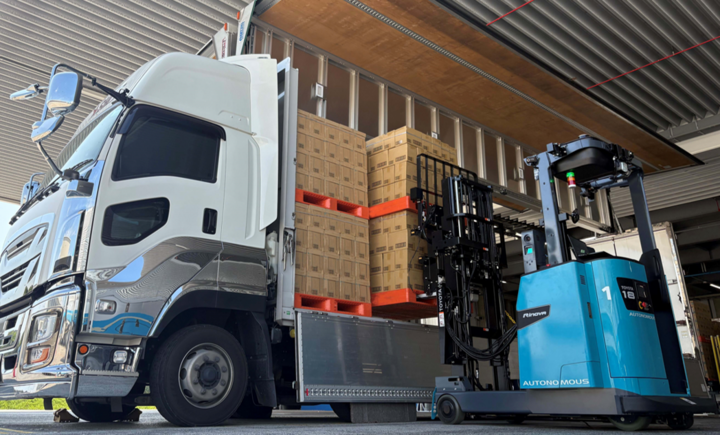
Why This Unmanned Forklift Truck Stands Out
What makes this product interesting is not only its autonomous driving capability, but the way it appears to be designed around the actual workflow. In many logistics environments, the real bottleneck is not whether a forklift can move by itself. The real bottleneck is how efficiently it can approach the truck, identify pallet positions, and complete loading or unloading tasks with fewer delays and fewer repeated actions.
Toyota’s official page for Rinova Autonomous confirms that the product is positioned as an automated forklift for truck cargo handling. According to Toyota, it is designed to detect truck stopping position and perform loading and unloading automatically, while helping reduce labor needs without requiring large-scale facility reconstruction.
From Automation Concept to Real Efficiency
In our view, this is where the modern Unmanned Forklift Truck begins to separate itself from earlier automation solutions. In the past, many manufacturers focused on whether the vehicle could navigate autonomously. Today, customers care much more about practical results:
- How many pallets can it move per hour?
- How stable is the operation across multiple shifts?
- How much labor can it realistically replace?
- How much can it improve truck turnaround time?
Those are the questions that define real value in warehouse and dock operations. A true Unmanned Forklift Truck must do more than move without a driver. It must perform the job better, faster, and more consistently.
A Product Built Around Truck Loading Logic
One of the most notable observations is the apparent focus on fork structure and handling efficiency. Rather than treating unmanned operation as the final goal, this design seems to focus on the next level: how to optimize the loading action itself.
That matters because truck loading is one of the most repetitive and labor-intensive logistics tasks. If a forklift can improve insertion accuracy, pallet recognition, and cycle efficiency, then the value of automation increases immediately. This is where the idea of the Unmanned Forklift Truck becomes more powerful. It is not just about replacing a driver. It is about upgrading the entire operating rhythm.
What Toyota Rinova Autonomous Tells Us About the Market
Toyota’s direction suggests that the future of the Unmanned Forklift Truck market will be defined by workflow-specific performance, not by general automation claims. On the official Toyota page, Rinova Autonomous is presented with several important technologies, including:
- 3D LiDAR-based truck bed detection
- Deep-learning-based pallet position and orientation detection
- Automatic generation of approach paths to the truck bed
These features show that the machine is being designed for a demanding real-world scenario. This is not automation for presentation. It is automation for operational use. In truck loading, small improvements in alignment, path generation, and pallet handling can lead to major gains in throughput.
The Competitive Standard Is Rising
This is why we believe the competitive standard for an Unmanned Forklift Truck is getting much higher. The market is moving beyond simple proof-of-concept automation. Buyers now expect solutions that can deliver measurable improvements in:
- Dock efficiency
- Cycle time
- Labor reduction
- Operational consistency
- Return on automation investment
As a result, manufacturers that continue relying only on broad automation messaging may find it harder to stand out. The next winners are likely to be the companies that can prove better performance in specific, high-value applications.
Why the Unmanned Forklift Truck Trend Matters for Logistics Operations
For warehouses, factories, and logistics centers, the rise of the Unmanned Forklift Truck is about more than labor savings. It is about creating a more stable and scalable operating model. Labor shortages, rising operating costs, and pressure for faster turnaround are pushing more businesses to evaluate automation not as a future concept, but as an immediate practical tool.
Truck loading and unloading is a particularly strong application because it combines repetitive motion, standardized flow, and direct labor intensity. A well-designed Unmanned Forklift Truck can improve both efficiency and predictability in this environment.
Final Thoughts
Toyota’s Rinova Autonomous shows how the Unmanned Forklift Truck category is evolving. The most important shift is not simply that forklifts are becoming autonomous. It is that they are being designed to deliver stronger real-world handling performance in high-value logistics scenarios.
From our perspective, this is the direction the market will continue to follow. The future of the Unmanned Forklift Truck will belong to solutions that combine autonomy with practical efficiency, especially in truck loading, pallet handling, and high-frequency logistics operations.
For readers who want to review the official Toyota product page, you can visit:
Toyota Rinova Autonomous Official Page