
When customers evaluate heavy-duty forklift, they usually do not begin with voltage platforms, axle brands, or mast geometry. They begin with practical questions. Is the truck reliable? Can it deliver stable performance under full load? Is the engineering mature enough for long-term operation? And if it is an electric model, does the system architecture make sense for real industrial use?
That is exactly why Linde’s heavy-duty forklift route deserves attention. From a customer’s point of view, the difference is not only about product specifications. It is about engineering philosophy. When looking at Linde’s large-tonnage forklift line, especially in the 20–32 ton range, it becomes clear that the company is not following the same path as many domestic Chinese manufacturers. For buyers, fleet planners, and technical decision-makers, that difference is worth studying carefully.
What Customers Notice First: A Different Product Character
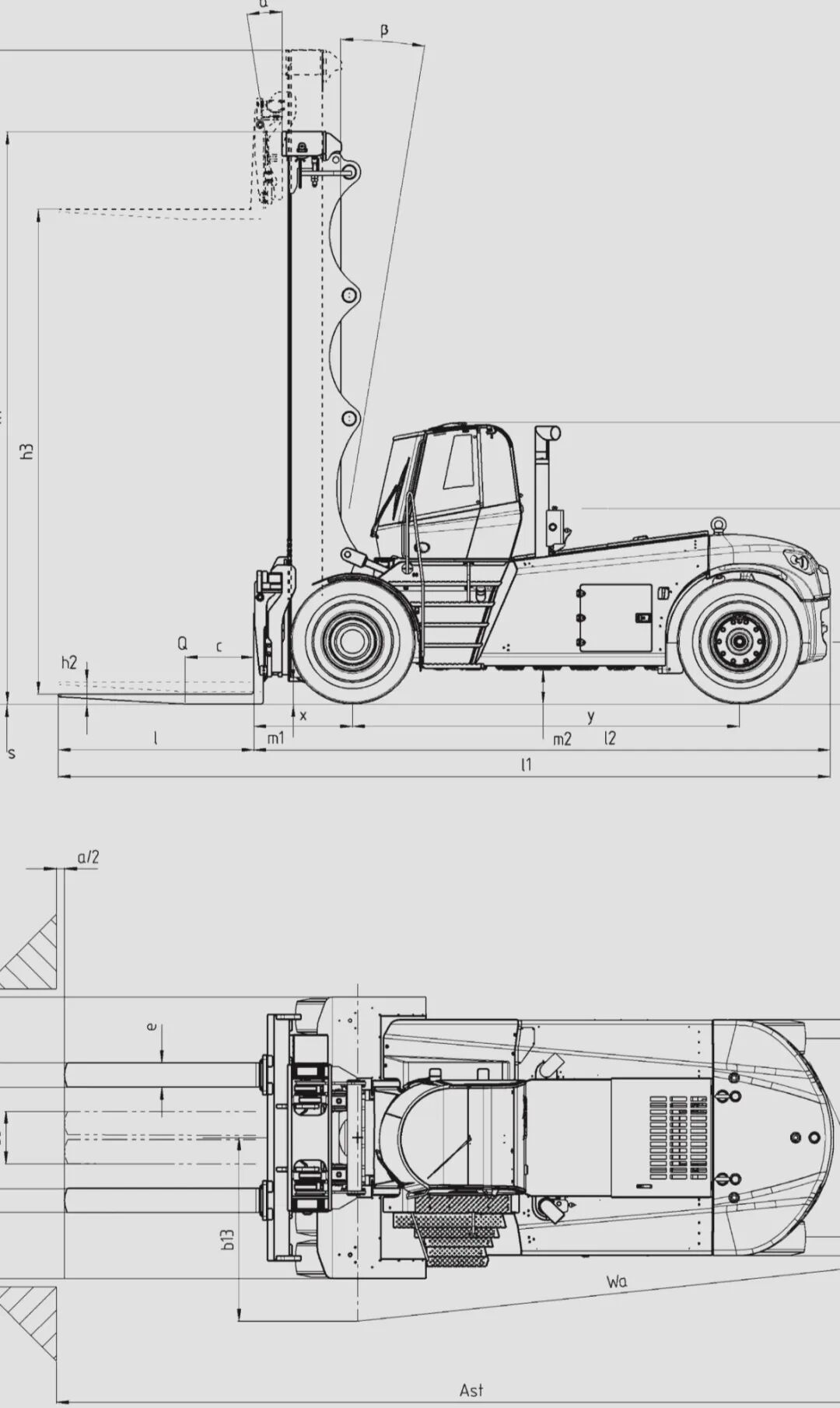
The first thing many customers notice is the overall machine presence. A sail-style mast combined with a 20–32 ton heavy-duty layout gives the truck a very specific visual identity. It looks stable, deliberate, and engineered for demanding work. That may sound superficial at first, but in the heavy equipment segment, visual structure often reflects design priorities. Customers who regularly work with port handling, steel, stone, timber, or large industrial loads understand that appearance often hints at how a machine has been balanced and built.
The supporting component choices reinforce that impression. Details such as a Kessler axle, Italian hydraulic valve block, and Cummins engine suggest that the machine is built around a mature international heavy-duty supply logic. For customers, that matters because it speaks to reliability, parts quality, service expectation, and system confidence. It does not automatically make one truck better than another, but it does show that Linde’s heavy-duty route is not based on simplified cost logic alone.
Why the Electric Side Is More Interesting Than It First Appears
From a customer standpoint, the most interesting part is not the internal combustion version. It is the electric direction. This is where Linde appears noticeably different from many domestic Chinese solutions.
In the Chinese market, large electric forklift development often moves toward higher voltage platforms relatively quickly. Depending on the application, 300V and 600V architectures are already common reference points. Linde, however, appears far more conservative. Even in the 18-ton electric forklift segment, available information suggests a 160V platform. For customers, that raises an immediate question: why would a premium manufacturer stay so conservative in voltage while the rest of the market moves higher?
The answer may be that “conservative” in voltage does not necessarily mean conservative in performance. For customers, voltage is not a goal by itself. Customers care about lifting speed, traction response, thermal stability, energy consumption, safety margin, battery layout, and long-term service behavior. A lower-voltage architecture that still delivers strong heavy-duty performance may reflect a very different engineering balance, one that prioritizes system maturity, component coordination, and lifecycle predictability rather than headline platform numbers.
What This Means for Customers Comparing Chinese and European Routes
For customers choosing between Linde and domestic Chinese heavy-duty electric forklifts, the real issue is not simply “which one has higher voltage.” The real issue is what each technical route means in practice.
A higher-voltage domestic solution may offer advantages in current reduction, motor power flexibility, and aggressive electrification strategy. That route can look highly competitive, especially in fast-moving markets where manufacturers are pushing electric transformation quickly.
Linde’s route, by contrast, may appeal to customers who value system conservatism, design discipline, and proven engineering balance over pure platform boldness. In other words, the difference may not be about who is more advanced in an absolute sense. It may be about who is optimizing for what kind of customer risk.
For some buyers, especially those entering heavy-duty electrification for the first time, a more conservative and integrated route may feel safer. For others, especially those seeking faster localization, stronger cost efficiency, or more aggressive electrical scaling, a domestic route may look more attractive. That is why this comparison is valuable: it helps customers understand that not all electric heavy-duty forklifts are trying to solve the same problem in the same way.
The 20–32 Ton Series Suggests a Broader Engineering Logic
Another point customers should pay attention to is that the 20–32 ton trucks appear to be treated as one coherent family. That is significant. In heavy-duty equipment, product family logic usually reveals how the manufacturer thinks about modularity, structural carryover, and powertrain planning.
At this tonnage level, if a machine can achieve respectable full-load lifting speed with a 75 kW motor on a 160V platform, that already tells customers something important. It suggests that performance is not being created by voltage alone. It suggests that the manufacturer may be relying on a broader optimization strategy involving drivetrain matching, hydraulic coordination, control logic, and structural efficiency.
For customers, this matters because it changes how specifications should be interpreted. A buyer should not only ask, “What is the voltage?” A better question is, “How does the complete machine achieve the required duty performance, and what does that imply for durability and service life?”
Battery, Counterweight, and Packaging Strategy Matter Too
Customers often focus first on battery capacity, but in large-tonnage electric forklifts, battery strategy is never just about capacity. It is also about counterweight function, space utilization, center of gravity, service accessibility, and overall truck balance. This is another area where Linde seems to differ from many domestic Chinese solutions.
From a customer perspective, that difference is important because heavy-duty forklifts are not only energy systems. They are handling machines under extreme load. Every design decision around battery placement affects stability, structure, and serviceability. If Linde’s battery and counterweight integration follows a different route, that is not a small technical detail. It directly affects how the truck behaves in real work conditions.
For customers planning long equipment lifecycles, this may be one of the most practical comparison points of all. A battery system that looks strong on paper but complicates weight distribution, heat control, or maintenance access may not be the better long-term choice. Conversely, a more conservative system that delivers better integration may create more value over time.
Mast Design May Be One of the Biggest Customer-Level Differences
If customers look closely at heavy-duty forklifts, mast design is one of the most revealing elements. It influences visibility, rigidity, load behavior, lifting confidence, and the overall feel of the truck under real operating conditions.
This may be one of the areas where Linde leaves the strongest impression. The mast design does not just look different. It feels like part of a broader heavy-duty philosophy. For customers, this is not a cosmetic matter. A better mast design can translate directly into operator confidence, safer handling, and more stable performance under demanding loads.
That is why customers comparing international and domestic solutions should pay attention not only to motor data and battery voltage, but also to the structural parts of the truck. In many cases, that is where engineering maturity shows most clearly.
What Customers Can Take Away from This Comparison
For customers, the key lesson is simple: Linde’s heavy-duty forklift strategy appears different because it is likely optimizing for a different balance of priorities. The route looks more conservative in voltage, but not necessarily less capable. It may be more focused on integrated system maturity than on aggressive platform numbers.
At the same time, domestic Chinese manufacturers are clearly moving fast, especially in high-voltage electrification and large electric forklift development. That route has its own strengths, particularly in speed, adaptation, and market responsiveness.
So the real customer question is not “Which route is right in theory?” The better question is “Which route fits the operating risk, performance target, and lifecycle expectation of the customer?”
Final Thoughts
From a customer’s point of view, Linde’s heavy-duty forklift technology route stands out because it does not seem to follow the same logic as many domestic Chinese solutions. The difference can be seen in voltage philosophy, drive direction, battery and counterweight integration, and mast design.
For buyers, this is useful because it helps frame the decision correctly. The comparison is not just about specifications. It is about technical route, engineering confidence, and the kind of long-term operating value a truck is built to deliver.
That is why Linde’s heavy-duty electric forklift direction is worth paying attention to. It shows that in this segment, product strategy is not only about being more aggressive. Sometimes it is about being more deliberate.